
Understanding how golf scoring works can seem daunting at first, but it’s quite simple once you break it down. You’ll need to familiarize yourself with terms like par, birdie, and eagle, which are essential for tracking your performance. Plus, knowing the difference between stroke play and match play can change your approach on the course. Ready to improve your game? Let’s explore the basics of scoring and what you need to know to keep track effectively.
Understanding Golf Terms: Par, Birdie, and Eagle
Have you ever wondered what terms like par, birdie, and eagle really mean in golf? Understanding these terms is key to grasping how the game works.
Par refers to the number of strokes an expert golfer is expected to take to complete a hole. If you score one stroke under par, that’s called a birdie; it’s a great achievement that shows your skill.
On the other hand, if you manage two strokes under par, you’ve hit an eagle, which is even more impressive. These terms help you measure your performance against the expected standard.
The Basics of Scoring: Stroke Play vs. Match Play
While both stroke play and match play are popular formats in golf, they offer different ways to compete and score. In stroke play, you count the total number of strokes you take over the entire round. The player with the fewest strokes at the end wins. It’s all about your overall performance across all holes.
On the other hand, match play focuses on head-to-head competition. You compete hole by hole, and the player who finishes each hole in the fewest strokes wins that hole. Your score is based on the number of holes you win, not the total strokes.
Each format has its unique strategy, so try both to see which you enjoy more!
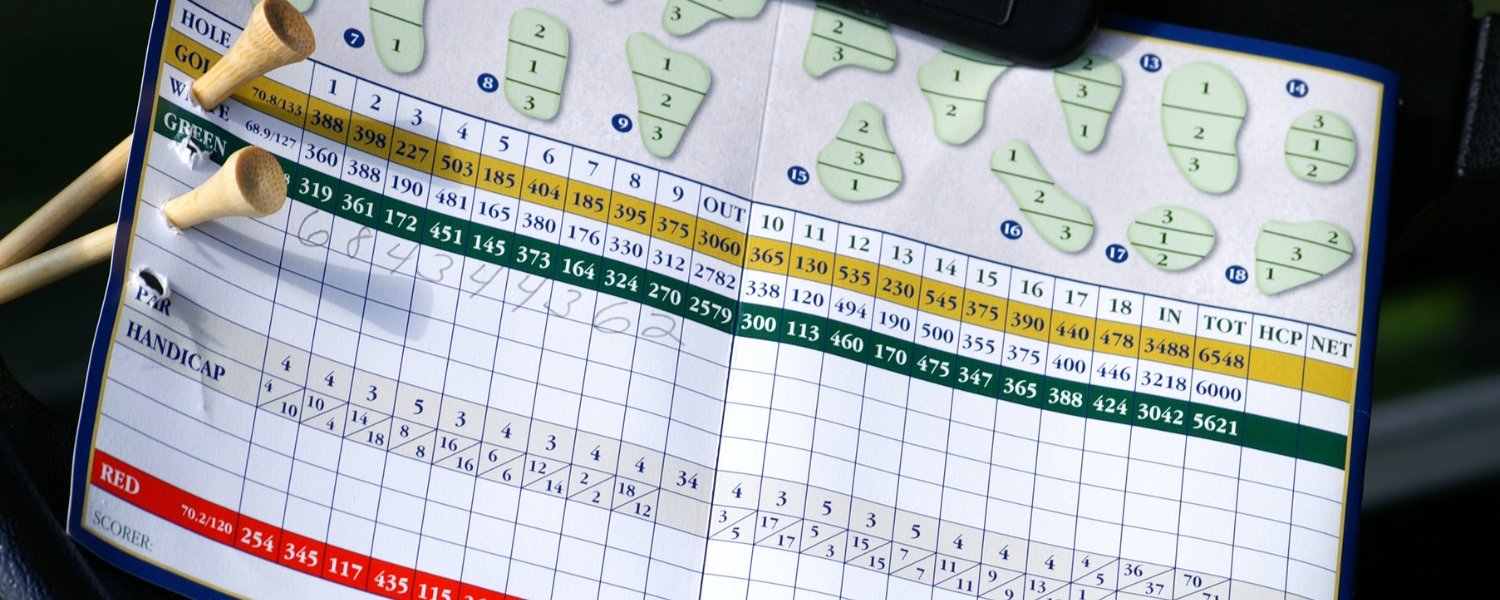
How to Keep Score: The Scorecard Explained
How do you make sense of a golf scorecard? First, familiarize yourself with the layout. Each hole has its par, which indicates the expected number of strokes.
As you play, write down the number of strokes you take on each hole. At the end of the round, add up your total strokes. Compare your score to the par for the course. If you took fewer strokes than par, you’ve scored under par; if you took more, you’re over par.
Don’t forget to keep track of your score against your playing partners, too. This helps you understand how you’re performing relative to others.
With practice, reading a scorecard will become second nature, making your golfing experience more enjoyable.
Common Scoring Scenarios: Tips for Beginners
Understanding common scoring scenarios can significantly enhance your confidence on the course. When you’re faced with a par-3 hole, aim for the green in one shot. If you miss, focus on getting up-and-down to minimize strokes.
On par-4 holes, if you’re on the green in regulation, you’ll have two putts to make par. Don’t stress about getting a birdie; it’s okay to play conservatively.
If you find yourself in a tricky bunker, remember to take a practice swing to gauge the sand.
For those challenging water hazards, it’s better to play it safe than risk a penalty stroke.
Always keep track of your score, and don’t hesitate to ask fellow players for tips—they’ve likely faced similar situations!
Frequently Asked Questions
How Is a Golf Handicap Calculated?
A golf handicap’s calculated using your recent scores, the course rating, and slope rating. You take your best scores, adjust them, multiply by a factor, and then average it to determine your handicap index.
What Is the Difference Between Front Nine and Back Nine?
The front nine refers to the first nine holes of a golf course, while the back nine covers the last nine. Each section can present different challenges, affecting your strategy and overall score. Enjoy the game!
Can You Use a Golf Cart During Play?
Yes, you can use a golf cart during play, but it often depends on the course’s rules. Just check with the staff to ensure carts are allowed on the specific holes you’ll be playing.
What Happens in a Tie During a Tournament?
In a tournament tie, you’ll usually play a sudden-death playoff to determine the winner. If that doesn’t work, a scorecard tiebreaker might be used, considering the best scores on the hardest holes.
Are There Penalties for Lost or Out-Of-Bounds Balls?
Yes, there are penalties for lost or out-of-bounds balls. You’ll typically incur a stroke penalty and must take a drop where the ball went out, adding strokes to your score. Stay focused and play smart!
Conclusion
In golf, understanding scoring can transform your game experience. By knowing terms like par, birdie, and eagle, you’ll better appreciate your performance. Whether you’re playing stroke play or match play, keeping track of your scores on a scorecard helps you monitor your progress. As you encounter various scoring scenarios, remember that practice makes perfect. Embrace the challenge, stay patient, and enjoy the journey of improving your skills on the course! Happy golfing!